


Cambridge, 1943
The London School of Economics has been evacuated from London to Cambridge for the duration of the war. Hayek teaches his classes, attends his fire-watching duties at the university, and writes.
The book begins as a memo to Sir William Beveridge, director of the LSE and one of the principal architects of what will become the British welfare state. Beveridge has been telling anyone who will listen that fascism was capitalism’s dying convulsion: the proof that free markets lead to tyranny. Hayek reads this and recognizes it as precisely backwards. Fascism and communism are not opposites. They are variants of the same thing: the concentration of economic control in the hands of the state. The road to serfdom does not run from capitalism toward socialism toward freedom. It runs from freedom through socialism toward totalitarianism, and the Western democracies are on it.
He writes the manuscript between 1940 and 1943, while Britain builds the wartime command economy that its socialist politicians intend to make permanent after the war. Every ministry that gains power to allocate materials, control prices, and direct labor during the emergency is a ministry that will resist giving that power back when the emergency ends. He has watched this sequence in Austria and Germany. He is watching it again in England.
The Road to Serfdom is published on March 10, 1944. Wartime paper rationing makes it that unobtainable book, as Hayek later calls it. It goes through five UK reprints despite the shortage. In the United States, the University of Chicago Press publishes it in September 1944, and in April 1945, Reader’s Digest publishes a condensed version that reaches millions of ordinary Americans who had never read an economics book. The book makes Hayek briefly famous and then, in British academic circles, briefly notorious. He receives thousands of letters from Americans who recognize what he is describing. He is invited on a lecture tour of the United States and greeted with crowds that surprise him and unsettle the English academic establishment.
The book is dedicated To the socialists of all parties. Hayek means it. The road to serfdom is not a left-wing road. It is the road that any government takes when it substitutes central economic direction for the choices of free individuals, regardless of which party is driving.
Freedom Cannot Be Cut in Half
The central structural argument of The Road to Serfdom is the one that the book’s critics spent the most energy trying to avoid: economic freedom and political freedom are not separable. You cannot have one without the other. Strip away the first and the second becomes, eventually, merely formal.
Hayek’s reasoning proceeds from a simple observation. Economic decisions are not a distinct category of decisions that can be handed over to state management while leaving everything else untouched. Every economic decision is a decision about how people live: where they work, what they can buy, which businesses can operate, which investments get made. When the state controls these decisions, it controls the terms on which every person in society exists.
Think about what economic freedom actually enables. The ability to change jobs protects you from an employer who mistreats you. The ability to start a business protects you from an employer who wants to suppress competition. The ability to save money protects you from dependence on whoever controls your current income. The ability to buy from any willing seller protects you from suppliers who want to dictate your choices. Every one of these freedoms is a check on the power of other people, including the power of the state, over your life.
Remove them and what remains? You can vote. You can hold opinions. You can write letters to your representative. But you cannot leave your state-assigned job, or purchase goods the state has not authorized, or invest in a business the planning bureau has not approved. Your political freedom is the freedom to express preferences about decisions that someone else will make regardless of your preference. This is not a “different kind” of freedom. It is’nt freedom at all.
Hayek is not arguing that every extension of state economic power leads immediately to a gulag. He is arguing that the same structural logic that makes a free economy free makes a planned economy unfree, and that the degree of unfreedom tracks the degree of planning. You can have some planning without going all the way. But you cannot have total planning and retain political freedom, because the two things require incompatible distributions of decision-making power.
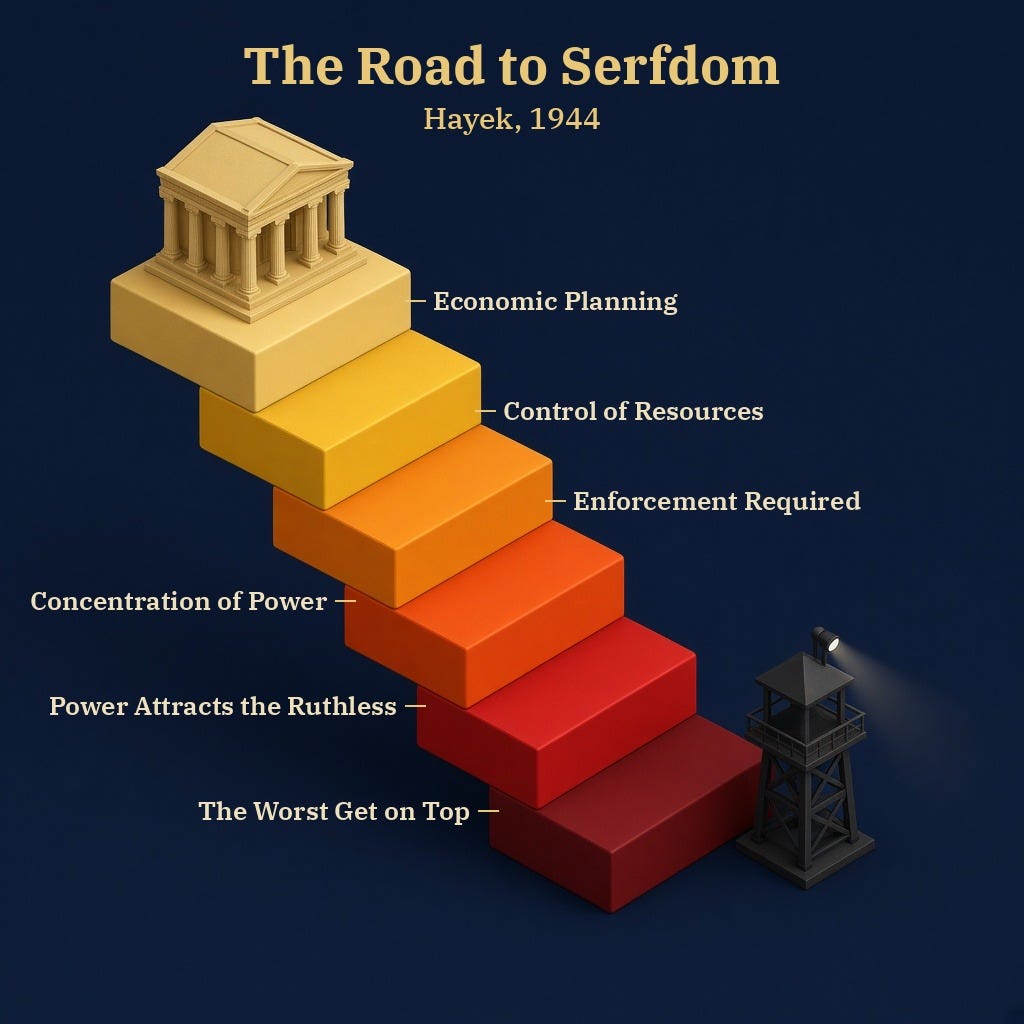
Why the Worst Get on Top
Chapter 10 of The Road to Serfdom is the most politically explosive thing Hayek wrote, and it has never stopped being explosive because the argument has never been adequately refuted.
The question Hayek asks is: in a system of central economic planning, who ends up in charge?
What does the planning authority require? It must make decisions about the entire economy: which industries receive resources, which businesses operate, which goods are produced in what quantities, what wages are paid, which investment projects proceed. These decisions affect every person in society. They require enormous concentrations of power. And they cannot be made by committee, because committees do not decide quickly or consistently enough to manage an economy. They require individuals, or small groups, with decisive authority.
Now ask what kind of person is willing to exercise that authority. Making economic decisions for an entire society requires overriding the preferences of enormous numbers of people who have different needs, different values, and different ideas about how their own resources should be used. People who are troubled by this, who feel the weight of imposing their judgment on others, who hesitate to override dissent, will not be effective central planners. The planning apparatus selects, over time, for people without those hesitations.
The people most willing to use power over others are not, as a group, the most admirable. They are the people whose self-confidence is not troubled by the visible harm their decisions cause, who can dismiss opposition as ignorance or sabotage rather than legitimate disagreement, who find the exercise of authority over others not burdensome but satisfying. In competition for positions within a planning hierarchy, these people consistently outperform the scrupulous. They promise more, deliver their promises with less uncertainty, and use the institutional levers of power more ruthlessly when rivals appear.
This is the selection mechanism. It does not require anyone to be deliberately evil; it requires only that the structure of incentives within a planning apparatus consistently rewards certain traits and punishes others. Over time, the apparatus fills with people who have those traits. The worst get on top not because planners set out to install them, but because the institutional structure of central planning produces that outcome as reliably as a free market produces low prices for goods in high supply.
Hayek is precise about what worst means here. He does not mean the most personally corrupt or the most psychologically deranged. He means the people least constrained by the moral sentiments that make coercion over others uncomfortable: the capacity for ruthless action that the planning apparatus, in competitive conditions, will reward above all other qualities.
The Consensus That Hayek Was Wrong
The Road to Serfdom triggered a revealing episode in the history of academic economics.
The British left, which Hayek had named directly as his audience, rejected the book with a force that occasionally shaded into personal hostility. Harold Laski, the Fabian socialist who chaired the Labour Party, called it a book the economists ought to repudiate. The argument in academic circles settled, over the following decade, into a comfortable consensus: Hayek had proven too much. His argument, if valid, would rule out not just Soviet-style central planning but any government intervention in the economy. Since democratic governments clearly could intervene without becoming totalitarian, the argument must be flawed. Case closed.
This was a misreading. Hayek explicitly writes in the book that he is not arguing against all government activity. He accepts a role for the state in providing certain public goods and a safety net of last resort. His argument is about the direction and degree of planning, not about whether government should exist at all. He is saying that the road runs in a particular direction: that each extension of central economic control creates conditions that make further extension more likely and reversal more difficult.
The consensus that he was wrong survived the postwar decades comfortably. Labour won the 1945 British election on a platform of nationalization and central planning, and the National Health Service was created, and the commanding heights of industry were nationalized, and the British economy did not immediately become totalitarian. The critics felt vindicated.
What they had not done was watch long enough. The nationalized industries underperformed for decades. The economic stagnation of the 1970s, when Britain’s state-managed industries combined inflation with unemployment in a combination Keynesian theory said was impossible, came and went before anyone in mainstream economics connected it to the structural argument Hayek had made in 1944.
The Thatcher government, when it arrived in 1979, cited The Road to Serfdom directly. Margaret Thatcher kept a copy and famously produced it at a Conservative Party policy meeting, placed it on the table, and said: This is what we believe.
Be He Was Right All Along
The permanent contribution of The Road to Serfdom is not a prediction that Western democracies will become the Soviet Union. Most of them have not and probably will not.
The contribution is the identification of a structural relationship between economic and political freedom that operates continuously, at every level of government intervention, not just at the extreme of total planning. Every regulation that removes a category of economic choice from individuals and transfers it to state authorities is a small movement along the road. The movement may be small enough that no individual step feels significant, but the direction does not change.
The practical application is to look for the mechanism Hayek describes operating at lower temperatures. The regulatory agency that began as a check on industry and over time becomes its protector. The licensing board established to protect consumers that gradually raises barriers to entry and protects incumbents. The central bank created to stabilize the currency that discovers it can also manage employment, and then growth, and then asset prices, each new mandate requiring more power to fulfill and generating more distortions that appear to require still more power to correct.
None of this requires a totalitarian endpoint to validate the argument. The mechanism operates continuously. The road runs in one direction. The question is only how far down it you have traveled, and whether you can see the direction you are moving.
In April 1945, when the Reader’s Digest condensation reached millions of American households, Hayek received letters from farmers and mechanics and small business owners who said they had been trying to articulate something that felt wrong about the direction their government was moving, and that he had given them the language for it. These were not people with economics degrees. They were people who lived inside free economies and felt, from the inside, what it meant to make their own economic decisions, and who recognized what it would mean to lose that capacity.
The academic economists who dismissed the book as alarmist had been trained to see economic systems from the outside, as objects to be managed. The people who understood the book immediately were the ones who lived inside them.
Economic control is not merely control of a sector of human life which can be separated from the rest; it is the control of the means for all our ends. Friedrich Hayek, The Road to Serfdom, 1944
Next: Article 12 - Man, Economy and State. Murray Rothbard reads everything Hayek wrote, concludes that Hayek stopped well short of where the logic leads, and spends the next decade building the most rigorous economic treatise of the twentieth century from a single axiom. He is twenty-five years old when he starts.
brave ai states that Rothbard wrote a scathing internal memo, to Volker Fund, regarding Hayak's "Constitution of Liberty" (1960). I do not know if this is true.
Well presented perspective 👏
The state should use its instrument of control in order to preserve the functioning of free markets not to replace them with a system of totalitarianism.